The Way and Remainder
03 Oct 2026


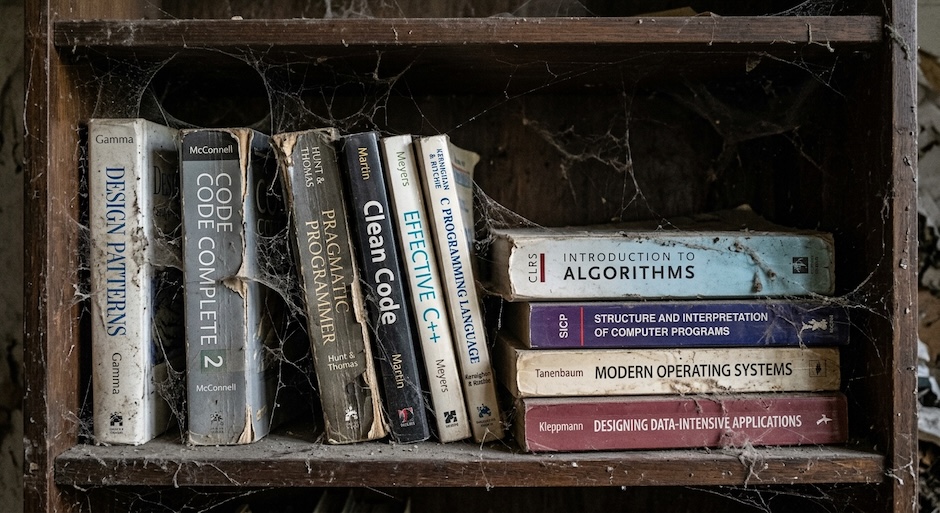
1970 - 2024: BCC Era (Before Claude Code)
Writing software in the “before times” was an iterative process, evolving from punching holes in paper all the way to clacking away on custom, clicky mechanical keyboards.
Through variations of this process, the steps were mostly the same:
- Understand the problem
- Come up with a solution
- Break the solution into parts
- Write code that solves each part
- Test that new things work
- Test that old things still work
- Repeat as needed
As time went on, patterns emerged. Then those patterns were overused and new patterns took their place. Programming dogma went from “everything can be functional programming” to “nothing can be functional programming” and so on and so forth.
Programmers held their strong opinions loosely and their irrelevant opinions tightly.
Tabs vs Spaces
Trailing commas vs leading
JavaScript or ???
It was messy, chaotic, frustrating, and extremely rewarding.
The Journey
The rewarding part was solving the problem, getting an answer and seeing it work. Reaching the destination at the end of the journey made the process rewarding.
A project spanning multiple development cycles saw patterns emerge. Technical discussions for each code change bred tribal knowledge used to guide future developers. Bespoke or unique solutions were adorned with comments explaining why they “looked weird”.
Along the way, solutions created the tectonic plates of a codebase and developers working on multiple projects borrowed solutions from one to another.
The journey taught developers where solutions could fit and where they might not. Where a pattern could technically “work” but did not belong.
Concurrently, developers were all on this journey. They started at different stages, progressed at their own pace and left trail markers for others to help find their way.
The Way
Over time, the journey paved the road and collectively developers decided “this is the way things are done”.
Each community within software developed their own “way” but at the root, things were more similar than they were different. When it was time to find others (interviewing), developers reached for tests to determine “do you know how to find the way?”.
Then, as always, people took it too far. Reductive, regurgitative tests (leetcode) became common gates of entry. However, even these monotonous assessments still held true to the core principle of:
- Identify the problem
- Find the solution
- Write the code
- Test it all
Then the world changed.
2025 - Present: AA Era (After A.I.)
Anthropic released Claude Code on May 22, 2025, ushering in a new age of software development. To be part of this all you needed was an internet connection and $20.
And for $20, developers had access to code generation and problem solving unlike any other. Project exploration, solution identification, implementation, and testing were just a few prompts away. Productivity soared.
Full applications could be written with comprehensive test suites. New functionality in existing projects created in hours instead of weeks. If someone could dream it and describe it, agentic coding could write it.
A.I. identified problems, came up with solutions, shipped mostly correct code and wrote tests to prove it. All without any developer showing A.I. “the way”.
The Remainder
With A.I. tools and agents responsible for the lion’s share of software development, humans became the remainder. The mixture of responsibilities in this remainder is shifting over time. Prompt creation, manual code review, click-testing, and other tasks fluctuate from team to team, project to project.
For organizations looking to hire developers, the picture of a good fit has been blurred.
For a given feature, what was done by the developer and what was done by the tool?
Without the journey to impart knowledge, what keeps the story in a codebase consistent? Does it need to be?
How is a developer’s “remainder” judged for fit?
Perhaps these questions become irrelevant as the tools get even more proficient. It could be that the “way” just will not matter as systems and organizations’ priorities change.
Or perhaps not.
Maybe the increase in demand for software engineers while A.I. tools are improving is a signal of times to come. In this new world of unlimited productivity, the “remainder” human tasks could be the differentiator.
As long as there are problems to solve and software to build, developers will have a seat at the table. Their impact will be directly correlated with how much they can navigate to the right destinations, the right solutions, the things that “fit”.
Choosing who sits in that seat will be harder over time. Building the skills necessary to sit there will be harder still.
At least we can stop fighting over tabs and spaces.